/


[EN] In his early years, Joachim Kühn pursued a career as a classical pianist before gradually expanding his horizons toward jazz, under the decisive influence of his older brother, clarinetist Rolf Kühn. The latter introduces him particularly to the worlds of John Coltrane and Ornette Coleman, whose free and innovative aesthetic would permanently shape his musical language.
His international career begins in 1963 at the Jazz Jamboree in Warsaw. After leading an influential first trio on the East German jazz scene, notably with Klaus Koch, he moves to West Germany in 1966, then to Paris in 1968, where he quickly establishes himself as a major figure in free jazz, also exploring the alto saxophone. In the 1970s, he further broadens his scope by embracing jazz-rock alongside musicians such as Jean-Luc Ponty, Philip Catherine, Zbigniew Seifert, and Aldo Romano.
However, it is in the trio format that his art expresses itself with the greatest intensity, revealing a virtuosity always dedicated to expressiveness. He collaborates with exceptional partners such as Jean-François Jenny-Clark and Daniel Humair, then later Rabih Abou-Khalil and Jarrod Cagwin, as well as Majid Bekkas and Ramón Lopez. As an improviser of great inventiveness, Joachim Kühn develops over the years a personal language based on his Diminished Augmented System, notably presented on the eponymous album released in 1999. This system, based on a sonic rather than strictly harmonic approach, opens new improvisational perspectives by transcending traditional tonal and modal frameworks.
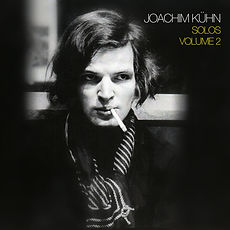
Among the notable collaborations of his career is his privileged relationship with Ornette Coleman, one of the few pianists to play with him. The album Colors, recorded live in Leipzig in 1996, testifies to this pivotal artistic encounter, which led Kühn to permanently join the saxophonist's quartet. Encouraged by Coleman, he also deepens his connection with the work of Johann Sebastian Bach, proposing singular interpretations, notably of the famous Chaconne from Partita No. 2. Within this rich and international trajectory, the collaboration with the cult label Futura Marge occupies a singular place. In March 1971, during two historic sessions at Studio Europasonor in Paris, Joachim Kühn records two solo piano albums that will become references in European free jazz: Solos, recorded on March 15, 1971, and Solos, Volume 2, recorded on March 19, 1971. These two albums capture Kühn's pure improvisation in all its freedom and virtuosity. This collaboration testifies to the shared commitment between the musician and the label around an demanding, free, and deeply contemporary jazz, solidifying Joachim Kühn's position as one of the major figures of European jazz for over five decades.
////////////////////////////////////////////////////////
[FR] Dans ses premières années, Joachim Kühn se destine à une carrière de pianiste classique avant d'élargir progressivement son horizon vers le jazz, sous l'influence décisive de son frère aîné, le clarinettiste Rolf Kühn. Celui-ci l'initie notamment aux univers de John Coltrane et Ornette Coleman, dont l'esthétique libre et novatrice marquera durablement son langage musical.
Sa carrière internationale débute en 1963 au Jazz Jamboree de Varsovie. Après avoir dirigé un premier trio influent sur la scène du jazz est-allemand, notamment avec Klaus Koch, il s'installe en Allemagne de l'Ouest en 1966, puis à Paris en 1968, où il s'impose rapidement comme une figure majeure du free jazz, explorant également le saxophone alto. Dans les années 1970, il élargit encore son spectre en s'ouvrant au jazz-rock aux côtés de musiciens tels que Jean-Luc Ponty, Philip Catherine, Zbigniew Seifert ou Aldo Romano.
C'est toutefois dans le
format du trio que son art s'exprime avec le plus d'intensité, révélant une virtuosité toujours mise au service de l'expressivité. Il collabore ainsi avec des partenaires d'exception comme Jean-François Jenny-Clark et Daniel Humair, puis plus tard Rabih Abou-Khalil et Jarrod Cagwin, ou encore Majid Bekkas et Ramón Lopez. Improvisateur d'une grande inventivité, Joachim Kühn développe au fil des années un langage personnel fondé sur son Diminished Augmented System, exposé notamment dans l'album éponyme paru en 1999. Ce système, basé sur une approche sonore plutôt que strictement harmonique, ouvre de nouvelles perspectives d'improvisation en dépassant les cadres tonaux et modaux traditionnels.
Parmi les collaborations marquantes de sa carrière figure sa relation privilégiée avec Ornette Coleman, dont il est l'un des rares pianistes partenaires. L'album Colors, enregistré en public à Leipzig en 1996, témoigne de cette rencontre artistique déterminante, qui conduira Kühn à intégrer durablement le quartet du saxophoniste. Encouragé par Coleman, il approfondit également son lien avec l'œuvre de Johann Sebastian Bach, dont il propose des interprétations singulières, notamment de la célèbre Chaconne de la Partita n°2.
Dans cette trajectoire riche et internationale, la collaboration avec le label culte Futura Marge occupe une place singulière. En mars 1971, lors de deux séances historiques au Studio Europasonor de Paris, Joachim Kühn enregistre deux albums de piano solo qui deviendront des références du free jazz européen : Solos, enregistré le 15 mars 1971, et Solos, Volume 2, enregistré le 19 mars 1971. Ces deux disques capturent l'improvisation pure de Kühn dans toute sa liberté et sa virtuosité. Cette collaboration témoigne de l'engagement partagé entre le musicien et le label autour d'un jazz exigeant, libre et profondément contemporain, confortant Joachim Kühn comme l'une des figures majeures du jazz européen depuis plus de cinq décennies.
PICTURE: ©DR - Joachim Kühn
releases